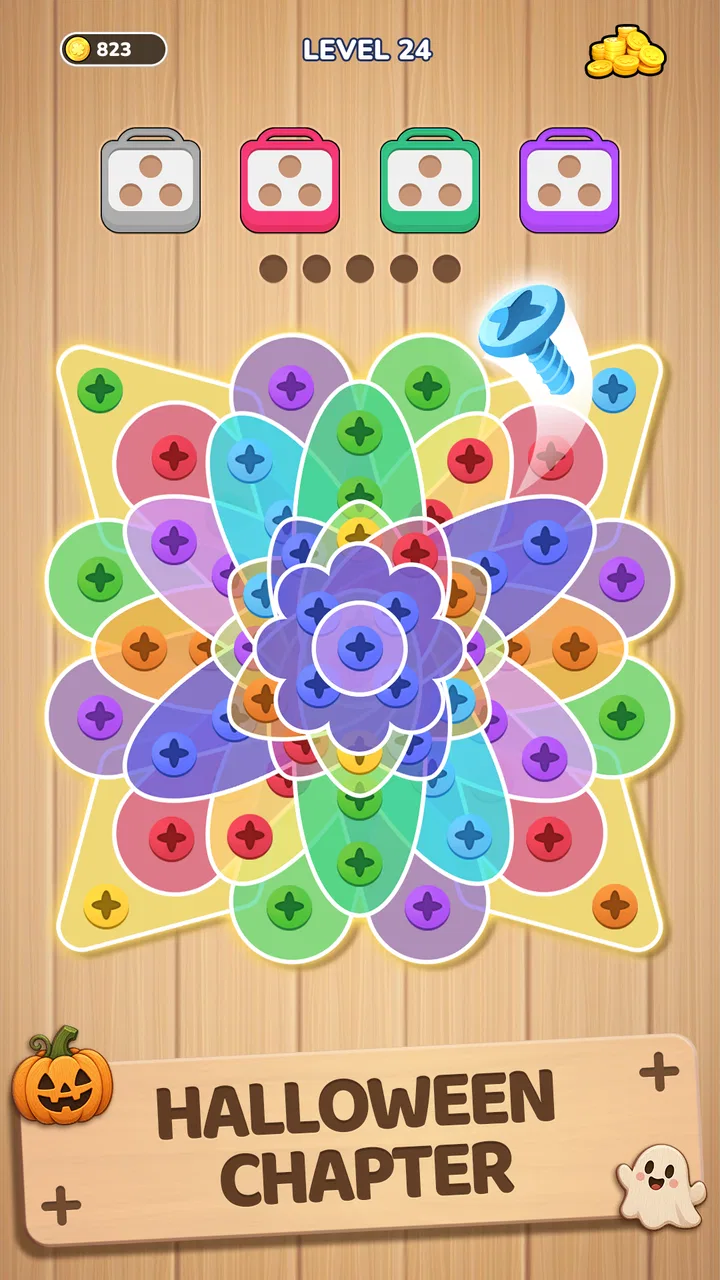
Woodle Screw® Pin Nuts & Bolts
- 4.8
- Rating
- 10.00M
- Installs
- Free
- Price

 Analysis by App-foxy
I spent time with Woodle Screw™ Pin Nuts & Bolts as a quiet, hands-on puzzle rather than a game I would rush through. Its basic idea is easy to understand: remove wooden pieces by managing screws, then sort colored pins so each move opens the next useful path. The presentation is simple, but the decisions become more interesting when a board gives you very little room to make a mistake.
This is a free puzzle game from LifePulse Puzzle Game Studio, aimed at players aged 10 and over. It belongs to the familiar sort-and-clear style, yet the wood-themed boards give it a more physical feel than a standard color-matching title. I found myself thinking less about matching colors quickly and more about the order in which I should dismantle the board.
The game has reached a 4.8 average from around 464 thousand ratings, with over 10 million installs. Those numbers suggest that its straightforward format has found a broad audience, but they do not tell you whether it fits your habits. My experience was more useful than the headline appeal: it works best when you enjoy short planning problems, accept occasional trial and error, and do not need every level to be equally demanding.
You May Also Like

 Blood Strike: 2.5 Anniversary
Blood Strike’s Loadouts Turn Every Drop Into a Tactical Gamble
A close look at Blood Strike’s custom loadouts: how fast access to signature weapons reshapes its battle royale rhythm, rewards preparation, and narrows the gap between fights.

 Pandora - Music & Podcasts
Pandora’s Music Is Easy to Start, but Harder to Recover
Pandora’s strength is its low-effort path from a seed to a station. Its weak spot is how much confidence it asks you to place in connection, setup, and quiet recovery.

 8 Ball Pool
 Is Built on Rivalries, Rematches, and Routine
A close look at the rivalries, rematches, shared routines, and unanswered safety questions that turn a quick pool match into a persistent mobile community.

 Samsung Music
’s Quiet Strength Is Playing What You Already Own
Its reach comes less from spectacle than from dependable access to a personal library. That simplicity is both the app’s strongest retention engine and its ceiling.

 AccuWeather: Weather Radar
AccuWeather Review: A Quick, Clear Forecast for Everyday Decisions
For everyday plans, the best forecast is the one you can understand quickly. AccuWeather makes rain timing, radar, and local conditions easy to act on, with a few trade-offs.

 Hill Climb Racing
Why Hill Climb Racing Still Turns Crashes Into One More Run
A tiny car, a bumpy hill and one more upgrade: Hill Climb Racing keeps resurfacing because its simple chaos makes every near-miss feel personal.
More From Our News Desk



How the basic puzzle loop feels in practice
Each board presents a wooden arrangement held together by screws and colored pins. My first instinct was usually to remove the most visible piece, but that was not always the sensible move. A screw can be easy to reach while still being strategically important, because taking it out may release several pieces or change the available space for later moves.
The baseline workflow I settled into was simple. I first scanned the whole board, identified the colors that were already close to being grouped, and then looked for the screw that blocked the largest number of useful actions. Only after that did I start tapping. This small pause made a noticeable difference, especially on layouts where an attractive early move created a dead end.
The color sorting is not just decoration. It gives the board a second layer of organization. I had to consider both the physical structure of the wood and the destination of each pin. Removing one piece may expose a pin that belongs somewhere else, but moving it too soon can occupy the space needed for a more urgent color. The best turns often came from preparing a place before making the obvious match.
That makes the game suitable for a quick break, but it is not completely mindless. A short session can feel relaxing when the board opens cleanly. On a tighter puzzle, I preferred to slow down and treat each move as part of a sequence. The contrast between those two moods is one of the game’s strengths.
The habit that prevents most avoidable mistakes
I recommend checking available spaces before touching the first screw. In this type of board, the limiting resource is often not the number of moves but the room needed to place or sort pins. If I cleared a piece without knowing where its pins could go, I sometimes made the next part harder for no real benefit.
A useful routine is to separate “opening” moves from “finishing” moves. Opening moves expose structure and create room. Finishing moves complete a color group or remove a nearly free piece. Mixing those purposes can lead to a messy board, while keeping them distinct makes the puzzle easier to read.
This is also where the game differs from a typical match-three alternative. Match-three games usually reward speed, chain reactions, or quick pattern recognition. Here, I got more value from restraint. The satisfying moment was not a large cascade; it was noticing that one carefully chosen screw made several later actions possible.
Why the wood theme changes the way I read the board
The wooden construction gives the puzzles a tactile identity. I found myself reading the board as a small object that could be taken apart, rather than as a flat grid of symbols. That distinction matters because overlapping pieces and blocked screws encourage spatial thinking.
It also creates a mild visual challenge. Similar brown tones can make the structure less immediately clear, particularly when several pieces overlap. I learned to focus on screw positions and pin colors instead of trying to understand the entire wooden shape at once. That approach reduced visual clutter and made the next action more obvious.
For someone who enjoys physical disentanglement puzzles but wants something available on a phone, this is a natural fit. For someone who prefers bright, instantly readable tiles, a conventional color puzzle may feel clearer and faster.
Settings, pacing, and the small choices that matter
When I install a puzzle game, I usually check the available settings before beginning a long session. In this case, the important practical point is not to assume that changing every option will improve the experience. I would review the sound and notification controls first, then adjust them to match the situation. A silent setup is better for a waiting room, while light audio can make a longer session feel more deliberate if you are playing at home.
The current version is 1.3.5, and the game runs on devices using Android 6.0 or later. That gives it a broad compatibility range, although the actual comfort of play will still depend on screen size and touch accuracy. On a smaller display, I would take extra care with taps near neighboring screws, because a puzzle based on precise selection is less enjoyable when the interface feels cramped.
I also recommend deciding in advance whether you want the game to be a five-minute distraction or a focused puzzle session. The same board can feel very different depending on your pace. Fast tapping encourages mistakes, while stopping after every move can make an easy level feel unnecessarily serious. My preferred rhythm was to make a short plan, execute two or three moves, and then reassess the remaining structure.
There is another setting-related habit worth mentioning: treat interruptions as part of the challenge. If I left a board halfway through and returned later, I sometimes forgot which screw I had identified as the key opening. Before pausing, I would mentally note the next intended action. That tiny habit prevented random tapping when I came back.
The game is free to download, with in-app purchases ranging from $0.99 to $149.99 per item. I would approach those purchases carefully and decide whether the basic loop already gives you enough value before spending. The free entry makes it easy to test the style, but players who dislike optional spending prompts or who prefer a completely fixed-price experience may be more comfortable with a paid puzzle alternative.
A repeatable scan for difficult boards
My most reliable scan has three passes. First, I look for screws that are visibly supporting several wooden pieces. Second, I check which colors have the fewest available destinations. Third, I identify any move that would consume a valuable empty space. This is more effective than simply searching for the easiest piece to remove.
The second pass is especially useful. A color with plenty of room can usually wait, while a color with limited room may need to be handled before the board becomes crowded. I did not always follow this rule, but it gave me a strong default when the layout was confusing.
The third pass is where experienced play separates from casual tapping. Empty space is not just a reward after clearing a piece; it is something to preserve. If a move fills the only convenient area for a later pin, I consider that a warning even when the move looks productive.
Faster patterns without turning the game into a race
Once I understood the baseline loop, I started looking for faster patterns. The best shortcut was not tapping speed. It was recognizing repeatable board situations. When a screw clearly blocked a stack of related pieces, I could often plan the opening in advance. When a color was already nearly organized, I tried not to disturb its route unless doing so created much more room.
I also became more willing to leave an apparently easy piece alone. This feels counterintuitive at first, because clearing anything seems helpful. In practice, a free-looking piece can be acting as a useful marker for the board’s structure. Removing it early may expose more choices without improving the overall position.
Another efficient pattern is to work in small groups rather than chase one color across the entire board. I would open one area, sort what became available, and then return to the central structure. This reduced the number of loose pins I had to track mentally. It also made mistakes easier to diagnose because I knew which action had changed the local area.
Players who enjoy speedrunning-style habits may be disappointed if they expect a pure reflex challenge. The faster I tapped, the more often I had to correct myself. The game rewards a different kind of efficiency: fewer unnecessary actions, better use of space, and a clear idea of what each removal is meant to accomplish.
How I use the game during an ordinary day
For a realistic everyday example, imagine having a short break between errands or waiting for an appointment. I would open a board, spend the first few seconds scanning it, and make only the safest opening move. If the next step was obvious, I would continue. If the board required deeper planning, I would stop rather than turn a brief break into a frustrating restart.
This makes the game more flexible than a puzzle that demands a long uninterrupted session. It is easy to pick up, but the better results come from remembering the board state. If you are frequently interrupted, choose a deliberate stopping point after clearing a section instead of pausing in the middle of a complicated arrangement.
For a longer evening session, I would alternate between straightforward boards and more demanding ones rather than forcing myself through every difficult moment. That keeps the physical dismantling theme relaxing instead of making it feel like a test. The game is at its best when the challenge is enough to focus you without making every mistake feel costly.
Where it compares well with familiar alternatives
Compared with match-three games, this title is slower and more spatial. You will not get the same emphasis on combos, timed reactions, or rapidly changing grids. That is a benefit if you want to think before acting, but a weakness if you play primarily for energetic feedback.
Compared with classic jigsaw apps, the pieces here are not assembled into a picture. The goal is to understand a mechanical arrangement and release it in a useful order. I found that more interactive than dragging flat shapes into place, although it can also be less forgiving when one early decision blocks your later options.
Compared with minimalist logic games, the wood theme adds atmosphere and physical context, but it may not provide the same clean abstraction. Players who love pure number puzzles or highly formal rule systems might prefer a game where every state is easier to calculate. Woodle Screw is more appealing when you enjoy visual objects and gradual dismantling.
Advanced limits and the situations where I would skip it
The main limitation is that the central action remains consistent: inspect, remove, sort, and open the next route. That consistency is the reason the game is approachable, but it can also make longer sessions feel repetitive. If you need constant rule changes, story progression, or a wide range of puzzle types, this may not hold your attention for very long.
It is also not the best option for players who become annoyed by imperfect information. Some boards encourage experimentation, and a wrong move can leave the remaining structure less comfortable to solve. I enjoyed that tension in moderation, but I would not recommend it to someone looking for guaranteed, instantly obvious solutions.
Touch precision is another practical consideration. On a compact phone, small screws and neighboring pieces can make a careful plan harder to execute. I would choose a larger screen when possible and avoid playing while walking or in a moving vehicle. The game is calm enough for casual use, but the board still benefits from attention.
The age rating is Everyone 10+, which feels appropriate for the puzzle style. Younger players who already enjoy sorting and construction problems may understand it quickly, while the planning element gives older players something to think about. Still, the presence of in-app purchase options means I would review spending controls before handing the device to a child.
I would also skip it if my priority were a fully offline-feeling, no-distraction puzzle environment with a single upfront cost. The free model is convenient for trying the game, but it is not automatically the best fit for every player. A paid alternative can be preferable when you value a more controlled experience over easy access.
What experienced players can realistically improve
There are no magical shortcuts that replace understanding the board. The strongest improvement comes from making the same checks every time: identify the structural blocker, protect useful space, and avoid moving a color simply because it is available. That repeatable discipline made my play faster without making it careless.
I also found it useful to judge a move by its next two consequences rather than its immediate result. If removing a screw opens a piece and creates a sorting slot, it is usually more valuable than a move that only clears one visible item. This forward-looking habit is a concrete way to turn casual play into more controlled solving.
When I made a mistake, I tried to identify the type of mistake instead of blaming the whole board. Was I too quick, did I fill a necessary space, or did I misunderstand which screw was supporting the area? That review helped me improve on later puzzles because the game’s recurring structure makes lessons transferable.
The trade-off is that deliberate play can reduce the relaxed feeling that attracted me in the first place. I would not analyze every easy board. I save the careful method for layouts that genuinely need it, keeping the simpler stages light and enjoyable.
My verdict after settling into the right rhythm
Woodle Screw™ Pin Nuts & Bolts is a good choice if you want a tactile-feeling sorting puzzle that rewards order, space management, and patience. I liked that the wooden boards make each level feel like a small dismantling problem instead of another flat color grid. The free price also makes it easy to try without committing immediately.
Its strongest quality is the balance between accessibility and planning. You can understand the objective quickly, but better results come from scanning the board and resisting the first obvious tap. That gives the game enough depth for repeat sessions, especially for players who enjoy improving their process rather than simply reaching the end.
Its weaker side is equally clear: the core loop can become repetitive, and players who dislike trial and error may find some arrangements irritating. The optional purchase range also deserves attention from anyone sharing a device with children or anyone who prefers a fixed-cost game.
After playing with a consistent routine, I would recommend it to fans of wooden screw puzzles, color sorting, and calm mobile challenges. I would point reflex-focused players toward a match-three game instead, and I would suggest a more traditional logic title to anyone who wants fully abstract rules. For me, the best way to enjoy this one is to treat it as a short mental reset: scan first, preserve space, make purposeful moves, and stop when the puzzle stops feeling fun.
LifePulse Puzzle Game Studio has built a focused experience rather than an all-purpose puzzle collection. That focus is both the appeal and the boundary. If the idea of carefully taking apart a wooden arrangement sounds satisfying, this is worth trying. If you need constant novelty, rapid action, or a completely purchase-free environment, I would choose something else.
FAQs for Woodle Screw® Pin Nuts & Bolts
01What is the main objective of Woodle Screw™ Pin Nuts & Bolts?
Woodle Screw™ Pin Nuts & Bolts is a puzzle game designed to challenge your problem-solving skills. The main objective is to strategically place various nuts and bolts to solve intricate puzzles. Players need to think critically to fit pieces together in the correct sequence, making it both engaging and educational.
02Is Woodle Screw™ suitable for all age groups?
Woodle Screw™ Pin Nuts & Bolts is designed to cater to a wide audience, including children and adults. The game features multiple difficulty levels, allowing users to start with simple puzzles and gradually tackle more complex challenges, making it suitable for both beginners and seasoned players.
03Does Woodle Screw™ require an internet connection to play?
Woodle Screw™ Pin Nuts & Bolts can be enjoyed offline, which is great for users who want to play without an internet connection. However, certain features, such as leaderboards or social media sharing, may require online access to fully utilize these options.
04Are there any in-app purchases in Woodle Screw™?
Yes, Woodle Screw™ Pin Nuts & Bolts offers in-app purchases. These may include additional puzzle packs, hints, or cosmetic enhancements. While the base game is free, these purchases can enhance the gameplay experience, though they are not necessary to enjoy the core content.
05How does Woodle Screw™ ensure user privacy and data security?
Woodle Screw™ Pin Nuts & Bolts takes user privacy seriously by employing robust encryption and data protection measures. The app only collects essential data for improving user experience and adheres to strict privacy guidelines, ensuring that personal information remains confidential and secure.
Pros
- Intuitive user interface for easy navigation.
- Wide variety of puzzle challenges available.
- Engaging graphics with vibrant colors.
- Frequent updates with new levels.
- Offline play mode available.
Cons
- Occasional ads can disrupt gameplay.
- Some puzzles may seem repetitive.
- Limited hints without in-app purchases.
- Requires ample storage space.
- No multiplayer or social features.

Woodle Screw® Pin Nuts & Bolts
Gallery